
To get a realistic lubricant OEM quote, start with a clear request. A general question like "how much does private-label engine oil cost?" usually brings back a very wide price range, or a list of questions in return. The reason is simple: contract manufacturing prices depend on formulation, performance level, packaging, volume and where the goods need to be delivered.
Here are 8 groups of information worth preparing. You don't need firm answers to all of them. Writing "not sure yet, need advice" is useful information too.
1. Target market and sales channel
Where will the product be sold (domestic or export, which region), and through which channel (parts dealers, workshops, retail, online, fleet or projects)? The market determines labelling, documentation and the performance level you need. The channel shapes pack sizes and your target price. If you are still deciding, see what should be your first lubricant product.
2. Product type
Motorcycle oil, scooter oil, passenger car or heavy-duty engine oil, hydraulic oil, gear oil or grease? Each group uses different formulations, raw materials and processes. If you plan several lines, say which one comes first.
3. Performance level and viscosity
Do you already have a target specification (for example API, JASO or ACEA) and viscosity grade (for example 10W-40 or 20W-50)? This is one of the biggest cost drivers. If you are not sure, describe the vehicles, operating conditions and price segment. A good advisor can recommend options from there.
4. Packaging and pack sizes
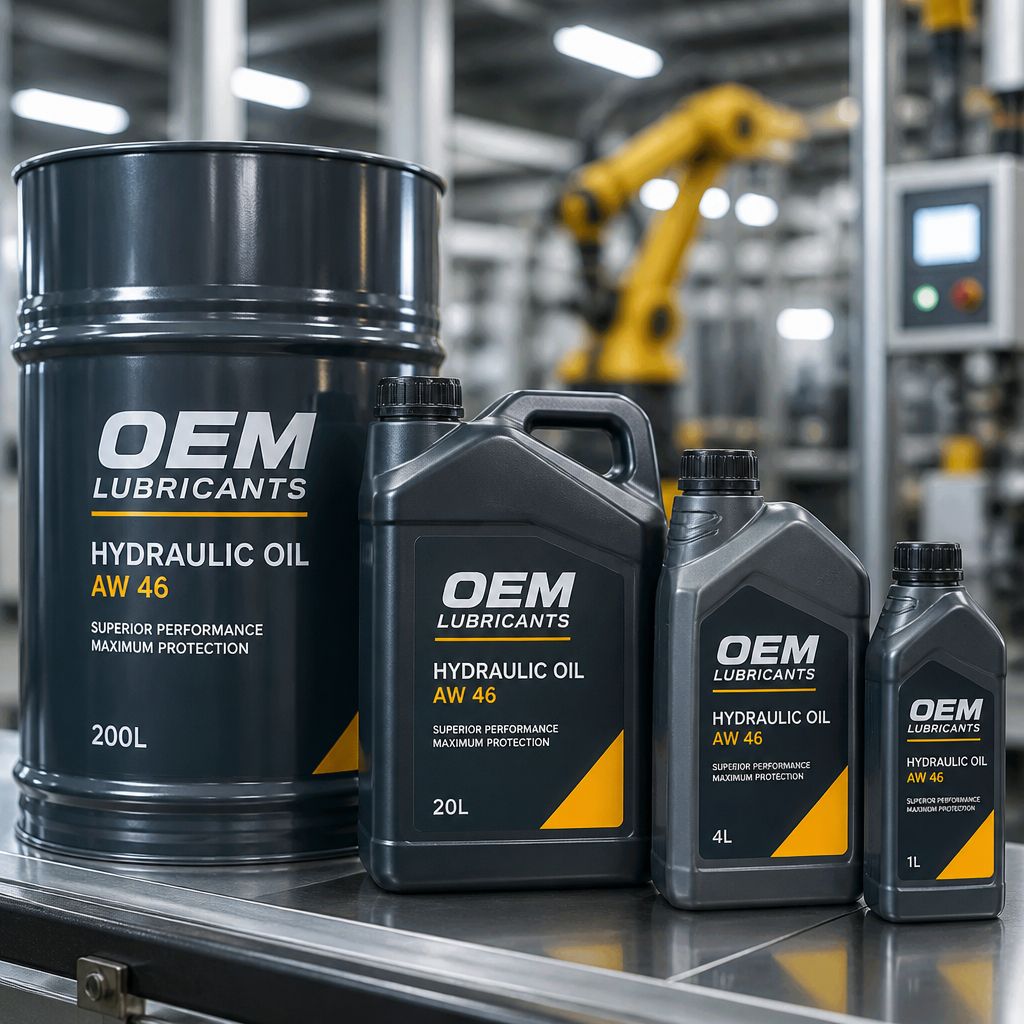
Volume per bottle, can or drum (0.8 L, 1 L, 4 L, 18 L, 200 L…), material and shape, custom mould or stock design, and carton configuration. Packaging is often a significant part of the unit cost. A custom mould usually comes with its own minimum quantity.
5. Label and brand identity
Do you already have a brand name, logo and label design, or do you need help from scratch? Which mandatory label information does your market require? State what you have and what you need. That way the quote can separate manufacturing costs from design work.
6. Expected volumes
Your first order quantity and a rough plan for the next 6–12 months, even if it is only an estimate. Volume directly affects the unit price and whether the factory's minimum order quantity (MOQ) can be met. A ramp-up plan also helps the manufacturer propose a sensible first order.
7. Delivery terms
Where should the goods be delivered: at the factory, at the port of loading, or to your warehouse? Do you need help with international freight, import procedures and customs clearance? Delivery terms (such as EXW, FOB, CIF or DDP) change what a quote includes. Budget also for the hidden costs behind building a lubricant brand.
8. Timing and other requirements
When do you need the goods? Do you have specific requirements for quality testing, samples, documents per batch or payment terms? Mention them early to avoid surprises after the price is agreed.
How to send a request that gets a fast answer
Put the points above into one message or form. Attach reference product photos or packaging samples if you have them. Mark clearly which points are still open and need advice. A complete request usually cuts down the back-and-forth considerably.
If you are exploring private-label lubricant OEM, you can send your request to DA Global Sourcing through the form on that page. Prices, minimum quantities and lead times are discussed case by case.
Frequently asked questions
Can I request a quote before I have a brand and label design?
Yes. Say which parts you need help with. A quote can separate production from design and brand work so options are easier to compare.
Why can two quotes for "the same oil" differ so much?
Usually because of a different performance level, base oil, packaging, volume or delivery terms. When comparing, put the quotes side by side against the 8 points above.
Do I need an exact quantity from the start?
Not necessarily, but give an estimate for the first order and the next few months. The clearer the volume, the more accurate the quote.